
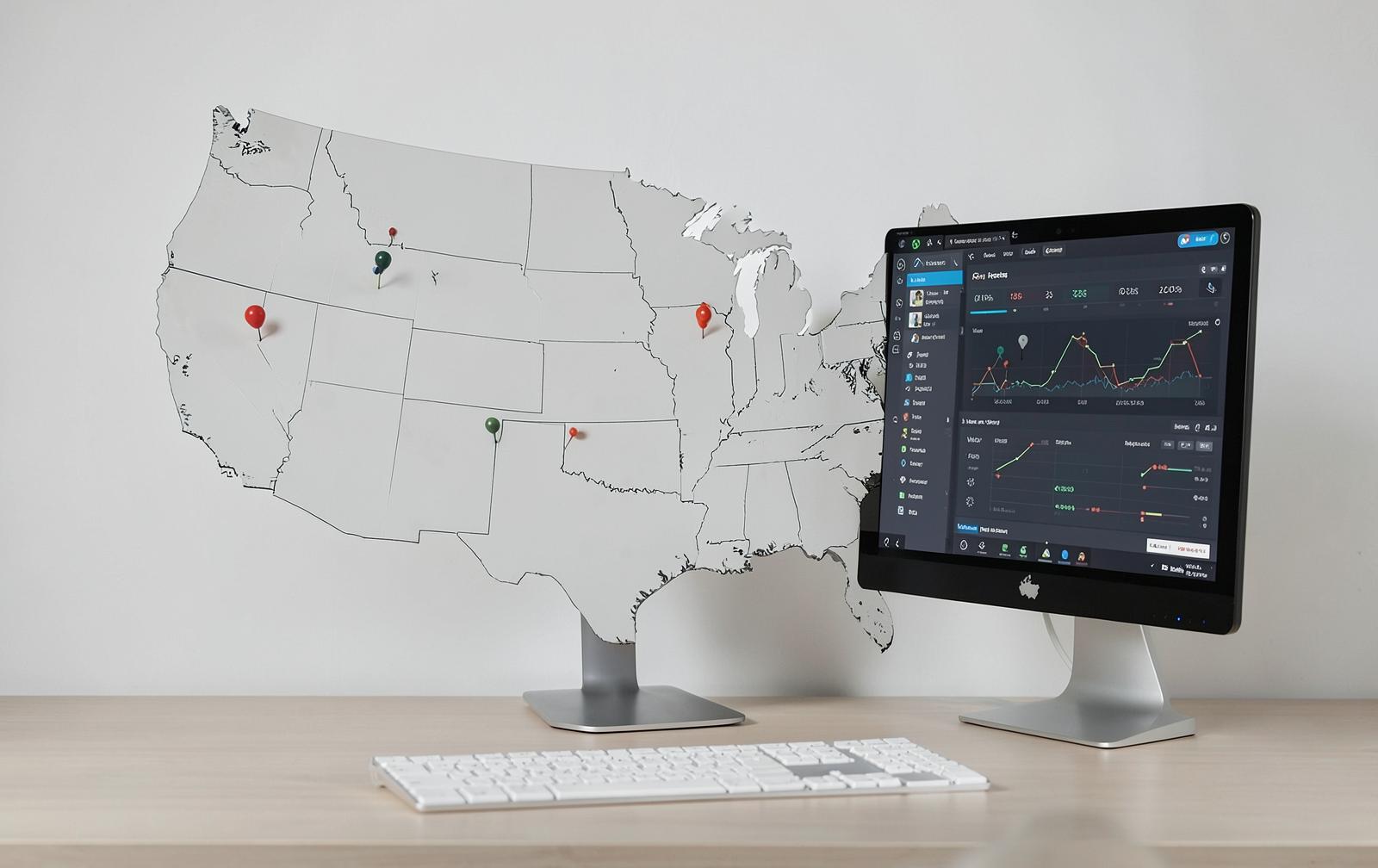
Most US companies expanding beyond one metro make the same mistake: they clone a city page thirty times, swap the city name, and wait. Google has been discounting that pattern for years. Ranking across Texas, Florida, California, Arizona and the Carolinas at the same time takes real local signals per market and honest handling of the places you serve remotely.
State intent and metro intent are different searches
"Texas HVAC contractor" and "HVAC repair Houston" want different pages. State-level queries are usually research and comparison; metro queries are ready to hire. Build both layers: a state hub explaining licensing, climate, regulation and pricing in that state, and metro pages under it with real jobs, neighborhoods and turnaround times.
Solution: one hub per state you actively serve, plus metro pages only for cities where you have completed work you can name. Fewer, deeper pages beat a thin fifty-state grid every time.
Google Business Profile is still the whole map pack
You can only have a profile where you have a real staffed location, and only that profile competes in the local map pack. Everything else has to win in the organic results underneath it.
Solution: fully build the profiles you legitimately have - categories, services, service areas, weekly photos, Q&A, and posts. For states without an office, accept that you are competing organically and invest the effort into content and links instead of chasing a pin you are not entitled to.
Reviews have to be local to count locally
A hundred reviews concentrated in one metro do little for your Tampa or Sacramento visibility. Reviews that name the city and the specific service are what move regional rankings, and recency matters as much as volume.
Solution: ask for a review at the moment of delivery, per job, with a direct link, and reply to every one within a week. Track review counts by state as a marketing KPI, not a customer-service one.
Links and mentions from inside each state
Regional signals come from regional sources: state trade associations, city business journals, chambers of commerce, local sponsorships, university and municipal pages. One link from a Dallas business journal outperforms a dozen generic directories.
Solution: for each priority state, list ten in-state publications, associations and partners, and pursue one relationship per month. Sponsorships and supplier partnerships create the most durable local links.
Structured data, NAP, and never inventing an address
Use LocalBusiness or ProfessionalService markup with areaServed listing the states and metros you cover, and keep your name, address and phone identical everywhere they appear. A virtual mailbox presented as an office is the fastest way to lose a profile entirely.
Solution: describe your model honestly - headquartered here, serving these states, on site within this radius. Clarity converts better than a fake pin, and it survives every algorithm update.
- Build state hubs for research intent and metro pages for hiring intent.
- Only claim profiles for real staffed locations; win the rest organically.
- Collect reviews per city, per job, and reply within a week.
- Chase in-state publications and sponsorships over generic directories.
- Use areaServed markup and never invent an address.